
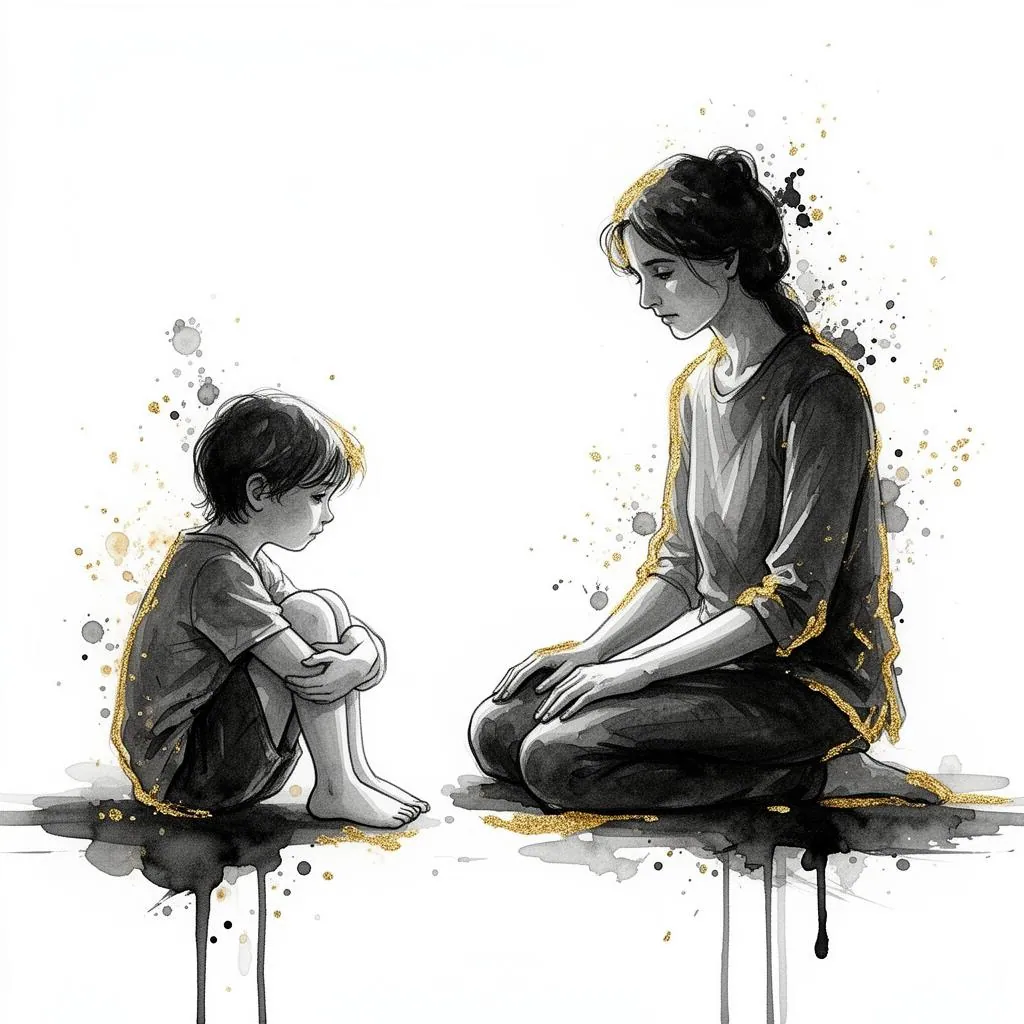
For parents who sometimes feel lost
Not every strain shows up as loudness.
Sometimes it shows up as exhaustion. As doubt. As the feeling of never being good enough. As an inner withdrawal, when you really want to be present.
You are not alone in this. And there is a way back — step by step.
Do you know these moments?
Many parents experience them, even if hardly anyone talks about it.
The guilt after the argument
You reacted more loudly than you wanted to. Now you lie awake wondering whether you hurt your child.
The inner withdrawal
You keep functioning, but inside you're not really present. The connection to your child feels thin.
The feeling of failing
You resolve to do it differently, and end up in the same place again. Over and over.
The deep exhaustion
Not just tired from daily life, but tired of constantly fighting against yourself.
Keeping up the facade
On the outside, everything runs smoothly. But inside you wonder whether other parents struggle like this too.
The doubts about yourself
Am I a good mother? A good father? Why is this so hard for me, when it seems easy for others?
You're not broken. Your system is overloaded.
What you're experiencing is not a weakness. It's the natural response of a person carrying too much, often without enough support.
Your nervous system protects you through withdrawal. Your self-criticism tries to "improve" you. But both cost energy that you need for the connection to your child.
The good news: you don't have to change everything at once. Small steps are enough.
The path from self-reproach to small changes
No perfection. No big upheavals. Only doable steps that really make a difference.
Recognize & understand
You understand why you react the way you do and that there's a reason for it. No judgment, only clarity.
Take off the pressure
You learn to calm your inner critic. Less fighting against yourself, more energy for your child.
Repair the relationship
Concrete exercises for the time after an argument. How to reconnect, in your own words, without a script.
Celebrate small wins
Every moment you respond differently counts. You see your progress, even on hard days.
Practical exercises for everyday life
Small interventions you can put into practice right away, even when you're exhausted.
Repair after the storm
No parent stays calm all the time. What matters is how you find your way back to each other afterwards. No justifying, no blaming.
- Get back to eye level
- Name feelings without reproach
- Offer physical closeness
Self-compassion pause
Pause briefly after a hard moment instead of tearing yourself apart. For the moments when you're hardest on yourself.
- Regulate your nervous system
- Activate self-compassion
- Stop the thought spirals
A small ritual
A fixed, recurring moment with your child. It doesn't have to be big, it has to be reliable.
- A reliable anchor point
- A brief moment of eye contact
- Touch without words
Evening parent reflection
Three questions at the end of the day that change how you see yourself. Without sinking into self-criticism.
- Note 3 small wins
- Consciously let go of guilt
- Start fresh tomorrow
Your compassionate companion
Luma understands, even on hard days
Luma is not a judge. She's an AI companion who listens when you need it, without judging. She helps you recognize patterns and gives you gentle nudges toward the next step.
- Available 24/7, whenever you need someone
- Notices your progress, even the small steps
- Suggests exercises that fit
- Helps you stay on track
Your progress becomes visible
As soon as you start, your personal space shows you week by week how far you've already come, even on hard days. The first step is a short analysis.
Common questions
rueckzug.sections.faq.sub
You don't have to do this alone.
The first step is often the hardest, but also the most important. Start with the free analysis and find out where you stand. No commitment, no pressure.
No credit card required • Cancel anytime • Your data is safe